
The US election campaign has provided plenty of ammunition for the CCP to make its case that its political system is superior.

'Biometric Aadhaar-based surveillance is not only about violation of privacy, but also about the treasure hunt for unprecedented financial surveillance and economic intelligence in the economic history of mankind,' asks Gopal Krishna.

"The RSS is trying to change the nature of India. Other parties haven't tried to capture India's institutions," he said.

The productivity of the Lok Sabha was 91.58 per cent while that of Rajya Sabha was 56.29 per cent.

'Modi's advent has made the mass of Indians realise that there was absolutely nothing wrong or objectionable in proclaiming nationalism as the masthead of the polity and Hinduism as its centerpiece,' says B S Raghavan, the distinguished civil servant.

The economy could return to 8% growth by the end of 2017-2018, says Arvind Panagariya, vice-chairman NITI Aayog.

'If the museum in his memory inspires and instils among Brahminical British Indians an attitude of equality towards Dalits, the edifice would be worth it,' reports Ashis Ray.

'Modi's campaign has been strikingly devoid of anti-Muslim rhetoric. After the kutta pilla incident, it has been several months since he said something horrible about the Muslims of India. It is the result of democratic constraints. He has to make compromises... He's trying to reinvent himself. He will politically hurt himself if 2002 becomes the definition of Mr Modi again', says political scientist Ashutosh Varshney.

The start of Indian lobbying in the US can be traced back to Pakistan's anti-India lobbying. Policy wonk Ashok Sharma documents this journey and its catalytic role in transforming the US-India relationship.

The visit of Park Geun-Hye to India, though a symbolic one, will certainly give a further impetus to the strategic partnership between the two countries says Rup Narayan Das.

To mark his 50th death anniversary, rediff.com has launched a special series to evaluate Jawaharlal Nehru's legacy.

American lawmakers and experts called for cutting off aid to the country and listing it as a state sponsoring terrorism.

The deal would allow Japan to export nuclear technology to India.

Finance Minister Arun Jaitley said measures should be taken to strengthen the Constitution and ensure that democracy is not subverted again.

A glance back at some important events that occurred in 2018.

President Pranab Mukherjee's visit to Israel is a final and critical step in the normalisation of relations between the two countries.

India and Brazil on Wednesday called for urgent progress in reforms of the UN Security Council, as they agreed to scale up bilateral ties and deepen cooperation in international fora.

Addressing a joint session of Parliament on Monday, President Pranab Mukhejee spelled out the Narendra Modi's government's agenda. Here are the highlights of his speech,
If the government does not allow the Opposition a few victories, then it is opening the door to paralysis and an entrenched culture of confrontation.

'We use the word "historic" perhaps too much, but the prime minister's visit certainly was historic in so many ways.'

The plan of UID/Aadhaar-based surveillance does not end with the collection of fingerprints and iris scan, it goes quite beyond it and poses a lethal threat to the idea of India, says Gopal Krishna.

Trade between India and Indonesia stands at $20 billion.
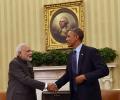
Furthering Indo-US cooperation on terrorism, Prime Minister Narendra Modi and President Barack Obama on Tuesday agreed to make "joint and concerted efforts" to dismantle safe havens for terror and criminal networks like Lashkar-e-Tayib, Jaish-e-Mohammad, Dawood-company, Al Qaeda and the Haqqani network.

The Indian Spring represented by Anna Hazare's anti-corruption campaign, which has culminated in the Aam Aadmi Party's impressive electoral debut in New Delhi, began around the same time as the Arab Spring in 2011 but they led to different outcomes in India and the Arab world, says Ramesh Ramachandran.

'In the first elections, Hindutva forces got only 6% of the votes and won only 10 seats.' 'It was a great defeat for them.' 'They have held that grouse against Nehru since then.'

Businessman P C Mustafa wants Indian Americans to return home, Cognizant CEO Francisco D'Souza outlines how Indian tech companies could grow, Gaurav Dalmia has some investment recommendations while Subramanian Swamy warns that India is flirting with a debt trap.

In a note to his students titled 'In a Background of Elections - The Development Debate', Dr Frazer Mascarenhas, principal of Mumbai's St Xavier's College, slams Narendra Modi's Gujarat and is in all praise of United Progressive Alliance's Rojgar Yojana and the Food Security Act

Since the US and India broadly share similar interests in Sri Lanka, they should coordinate closely to ensure that the country preserves its democratic institutions, says Lisa Curtis
Over two dozen Muslims have been elected to the Lok Sabha. This shows that all is not lost for India's Muslims, suggests Mohammad Sajjad.
'When George Bush Senior decided in 1992 that India and the United States must start talking in this-now-changed world, who would have thought that 10, 15 years down the road, we will start looking at each other as strategic partners?'

Prime Minister Narendra Modi on Thursday address Members of the British Parliament in London where he promised to open more doors of cooperation between the two countries and delved on issues like terrorism and United Nations reforms.
The State is trying to curb the students movements, therefore, there are suspicions against some of the Subramanian report on education's recommendations, says Mohammad Sajjad.

Fencing the border between Myanmar and Nagaland is expected to adversely affect the Naga tribals. Gautam Sen, an expert on Nagaland, explains why the Indian government needs a more comprehensive and long-term perspective on this issue and why it must take local tribal sensitivities and customs into account.

'What gives hope is that Modi's own leadership is vitally linked to his capacity to deliver on the economic front. Indeed, if he succeeds, India's foreign policies will have changed beyond recognition,' feels Ambassador M K Bhadrakumar.

'Over the last two decades, the India-French relationship has grown steadily, no major political difference having darkened the sky between Paris and Delhi,' says Claude Arpi.

While Nehru remains an icon for many, including his critics, for the stellar role he played in building institutions of democracy, the 1962 humiliation blots Nehru's copybook, says Colonel Anil A Athale (retd).
It has been said that by 2025, India could become among the top five economies in the world. If India does become a $5 trillion economy but gets all its rivers polluted, food chain poisoned and genetic pool depleted and biometric database of Indians sold or stolen at the behest of commercial czars, will it not be a pyrrhic economic victory, asks Gopal Krishna.

Amid souring ties, the president visited Beijing for three days. On his return to India, a hope of better ties has arisen, says senior correspondent R Rajagopalan, who travelled with Pranab Mukherjee to the Asian superpower.


Justice Ranjan Gogoi, who will demit office as the Chief Justice of India in a week's time, has etched his name in the annals of history by giving finality to one of the most politically and religiously sensitive cases, the Ayodhya land dispute, which dates back to even before the Supreme Court came into existence in 1950.
 © 2026 Rediff.com - Advertise with us - Disclaimer - Privacy Policy - Sitemap - Feedback - About us - Terms of use - Grievances